
How many alcoholic drinks per week? The official guidelines
"How many drinks a day is too many?" French health authorities have set out clear guidelines: Santé publique France (the national public health agency) and the National Cancer Institute recommend no more than 10 drinks a week, no more than 2 drinks a day, and some days with no drinking each week. In short: "a maximum of 2 drinks a day, and not every day". These guidelines are the same for women and men, and they rest on one finding: health risks exist from the very first drinks, and rise with the amount.
What is a "drink"?
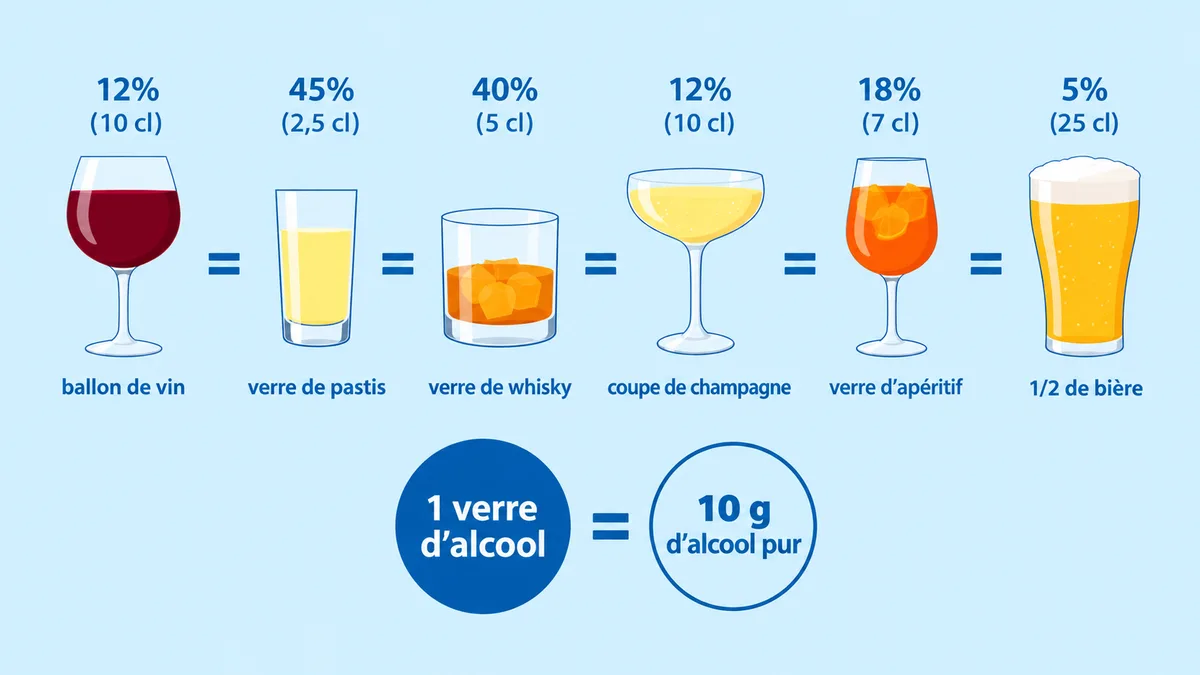
The guidelines talk about standard drinks. A standard drink contains about 10 grams of pure alcohol, whatever the beverage. A few equivalents:
- a half-pint of beer (25 cl) at 5%;
- a glass of wine (10 cl) at 12%;
- a glass of champagne (10 cl) at 12%;
- a measure of whisky or another spirit (3 cl) at 40%.
Drinks poured at home or in a restaurant are often fuller than these measures: a large glass of wine can equal two standard drinks. And for the same amount of pure alcohol, wine, beer or spirits carry the same risks: it isn't the type of drink that counts, but the amount of alcohol.
How to read these guidelines
These guidelines are ceilings, not targets. A few useful points:
- The three elements go together. Staying under 10 drinks a week isn't enough if you have 6 in one evening.
- You can't "bank" drinks: 10 drinks over a weekend are not the same as 10 spread across the week. Heavy drinking on a single occasion adds its own risk: accidents, risky behaviour, putting yourself in danger.
- Alcohol-free days count. They let the body rest and also show that you are free not to drink.
- Following the guidelines doesn't mean zero risk. They limit the risk, they don't remove it.
- Nothing obliges you to drink. These guidelines are for people who drink, not for those who don't.
Situations where the right level is zero
In some cases the advice isn't to "drink less" but not to drink at all:
- during pregnancy and breastfeeding;
- before driving or handling a machine;
- if you take certain medicines, or in case of illness (liver, pancreas, heart…): ask your doctor or pharmacist;
- before adulthood: alcohol is not recommended for teenagers, whose brains are still developing.
Going over the guidelines: does that mean dependence?
No, not automatically. Going over the guidelines means you are exposed to increased risks (liver disease, cancers, cardiovascular problems, accidents, sleep and mood disorders, etc.). Dependence is something else: loss of control, strong craving, carrying on despite the harm, needing larger amounts, feeling the lack when you stop.
The two can exist separately or overlap. To see more clearly, several tools exist:
- the alcohol test (AUDIT-C) on the site;
- the article How to tell if alcohol is taking up too much space;
- the Alcohol addiction page to understand the general picture.
If you go over these guidelines
- Take stock. For a week, note what you drink, when, with whom, why. The raw numbers are often revealing.
- Try cutting down gradually, with precise limits and alcohol-free days.
- Talk about it to someone close, your doctor or a professional: you don't have to wait until "you have a problem".
- Be careful if your drinking is daily and heavy: stopping abruptly can be dangerous. Get medical advice first.
Alcool Info Service (0 980 980 930, a French number) answers questions about your own drinking or a loved one's, anonymously. The website alcool-info-service.fr completes this service with information and tools to take stock.
Further reading
- Taking stock of your use: noticing without judging yourself
- Cutting down or quitting: how to choose your goal
- Baclofen and Alcohol: What Science Says in 2026
- Binge drinking in young people: when episodes should raise concern
Frequently asked questions about drinking guidelines
Is there such a thing as risk-free alcohol use?
No: according to Santé publique France, the risk exists from the first drinks and rises with the amount. The guidelines aim to limit that risk, not remove it. If you don't usually drink alcohol, nothing justifies starting.
Are the guidelines the same for men and women?
Yes, since 2017 the French guidelines have been identical: no more than 10 drinks a week, no more than 2 a day, some alcohol-free days. Each body reacts to alcohol in its own way, however, which calls for individual care.
Why do you need alcohol-free days?
They limit daily drinking, which is linked to a higher risk, and let you check that you keep the freedom to do without. If that's hard, it is useful information to share with a professional.
Is a very heavy night out now and then serious?
Heavy drinking on one occasion carries immediate risks (accidents, falls, risky behaviour, alcohol poisoning) even if the weekly total stays within the guidelines. If these episodes keep happening, they deserve a closer look.
If you are asking yourself questions about your drinking, you can book an appointment to talk about it without judgment.