
The stages of change (Prochaska and DiClemente): why deciding isn't enough
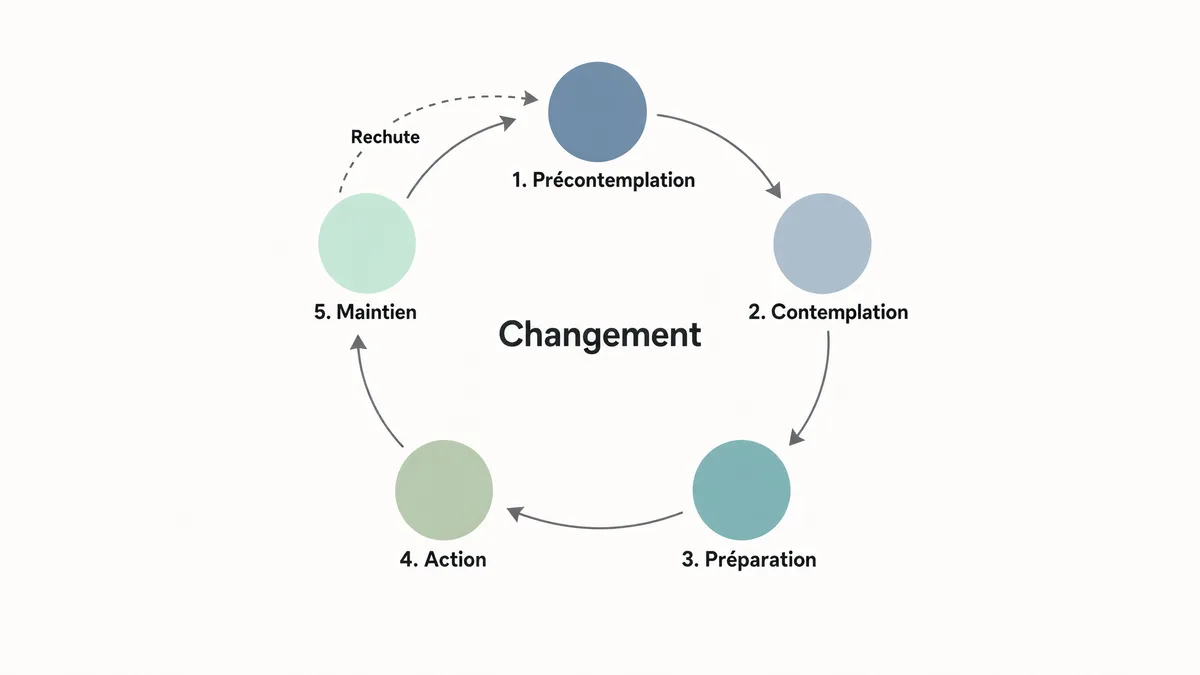
The model in one sentence
In the 1980s, American psychologists James Prochaska and Carlo DiClemente proposed a model that became a reference point for understanding behaviour change: the transtheoretical model of change. Its central idea fits in one sentence: people don't change a behaviour all at once, through a single decision — they move through a series of stages, and it's normal to cycle through them more than once before a change actually holds.
The stages, one by one
- Precontemplation: the person hasn't yet identified a problem, or doesn't feel concerned. This isn't denial in a moral sense — often, the behaviour still serves a real purpose, and its cost isn't yet felt as outweighing its benefit.
- Contemplation: doubt sets in. Change is being considered, but ambivalence remains — good reasons to continue and good reasons to stop coexist, sometimes for a long time.
- Preparation: the decision is made in principle, but not yet acted on. Information gathering and concrete options start to take shape.
- Action: change is actively underway — behaviour is genuinely being modified.
- Maintenance: the new habit consolidates over time, with ongoing vigilance around high-risk situations.
Good to know. These stages aren't a staircase climbed once and for all. It's normal to move forward, slip back, or stay at one stage for months — that's how the model normally works, not a sign something's wrong.
Relapse as a possible stage in the cycle — not a failure
This is arguably the most useful contribution of the model: relapse is described as a possible moment in the cycle, not its end. Someone who relapses after an action phase doesn't strictly "start from zero" — they typically return to a contemplation or preparation stage, carrying more experience, not less. This framing changes how a "setback" gets interpreted: less as proof of incapacity, more as information about what still needs adjusting.
Why this model changes how we see ourselves or a loved one
For the person themselves, knowing which stage they're at helps avoid judging themselves by the standards of a stage they haven't reached yet — you can't "take action" before you're ready, and that isn't a lack of willpower. For loved ones, the model helps explain why impatience or pressure often only triggers pushback: no one can push another person through a stage from the outside — you can only make the transition easier once they're ready.
Worth noting. This model is a helpful reference point, not a diagnostic tool or a timeline. It can't predict how long a given stage will last for any specific person.
The model's limits
The transtheoretical model simplifies a process that is, in reality, more complex and non-linear. It doesn't replace an individual assessment, doesn't predict any one person's path, and shouldn't be used to label someone ("they're still in precontemplation") in a fixed or judgmental way.
How professionals use it
An addiction specialist often uses this framework to adapt their approach to where a person actually is, rather than offering the same thing to everyone: working with someone still ambivalent in contemplation looks different from working with someone actively in an action phase. This kind of tailored support is part of what good addiction care looks like.
Frequently asked questions
Do you have to go through every stage in order?
The model describes a cycle rather than a straight line: returning to an earlier stage more than once before a change lasts is normal — not a failure or an anomaly.
How long does each stage last?
There's no universal duration: it depends on the person, their situation, and what they're going through. The model sets no timeline.
Does relapse mean starting all over again?
No. A relapse usually brings someone back to an earlier stage in the cycle (often contemplation or preparation), with the experience gained along the way — not back to square one.
Does this model apply to all addictions?
It was designed generally for behaviour change, and applies to both substance addictions and behavioural addictions.
This article is for general information only and does not replace individual medical advice. Browse our other articles on addiction or subscribe to our newsletter.